GEO tools show you the gap.Your content platform closes it.
What is generative engine optimization (GEO)?
GEO is the work of making your product content readable to AI-powered search engines, so it can be compared against competitors and surfaced when shoppers ask AI assistants for recommendations. For enterprise retail, this means your product attributes, specifications, and brand context need to be machine-readable at the scale of your full catalog, not just on a handful of flagship pages. ChatGPT, Gemini, Perplexity, and Google AI Mode don’t return a list of links to a retailer’s website. They synthesize a single recommendation from the most reliable, clearly structured product data they can find. If a competitor’s catalog is structured and yours isn’t, the agent recommends the competitor, regardless of price or brand strength.
The key difference from traditional SEO is the goal. SEO competes for ranking position. GEO competes for inclusion in the answer itself. If you’re managing tens of thousands of SKUs, that shifts the work from page-level keyword optimization to catalog-wide content infrastructure. Vague or unstructured product content doesn’t get penalized. It gets ignored.
What is answer engine optimization (AEO)?
AEO is the work of formatting content so AI assistants and voice search tools can extract a direct answer without the user needing to visit your site. AEO is most visible in FAQ content, product definitions, and how-to guidance. When someone asks Siri, Alexa, or ChatGPT a direct question, the response they receive is an AEO win for whichever brand had the clearest, most structured answer.
GEO and AEO are closely related but they’re not the same. AEO focuses on the extractability of a specific answer from a specific piece of content. GEO is broader. It covers overall citation authority, content consistency across a site, and the structural quality of your content estate as a whole. Both require the same foundational infrastructure. Getting that infrastructure right is what allows the tactics to work.
The shift to zero-click search is already happening
For two decades, the acquisition model was predictable. You optimized product pages for keywords, ranked in the top positions, and earned the click. That click brought a high-intent shopper to your product detail page where you could guide them through the funnel. Gartner predicts that traditional search engine volume will drop by 25% by 2026 as shoppers turn to conversational AI for discovery. The top of the funnel is now the AI’s generated response, not your landing page.
McKinsey projects agentic commerce will reach $3 to $5 trillion globally by 2030.
The GEO tools diagnose the problem. They don’t solve it.
Profound, Adobe LLM Optimizer, and the GEO monitoring platforms now entering this space all do a version of the same thing. They track where your brand is cited and flag where it’s missing. None of them produce the content that closes that gap. Amplience does, across the headless CMS that structures content at source, the DAM that attaches the metadata AI needs, and Workforce that produces it at catalog scale.
What AI systems need from your content
AI systems don’t read your website the way a human does. They query your content programmatically, looking for structured data they can extract, verify, and attribute. A single block of HTML that mixes a product name, description, specifications, and marketing copy together gives an AI model nothing to work with. It can’t tell where the spec ends and the marketing copy begins, so it skips the page entirely. It can’t tell where the material ends and the care instruction begins. Ambiguous content gets deprioritized, not because the AI decides it’s low quality, but because it can’t confidently extract the information it needs.
The signals AI systems use to evaluate content are consistent across platforms. Structured product attributes, rich and accurate metadata, clean API delivery, content that matches schema definitions, and freshness signals that show the content is current. Each of these is a property of how your content is stored and managed, not something that can be retrofitted page by page.
If your content lives in a legacy CMS as unstructured text blocks, it is invisible to AI by default. Amplience’s headless CMS changes this by storing every content attribute as a distinct, labeled field rather than a narrative block. When an AI system queries a product, it gets each attribute as a separate, verifiable data point, not a paragraph that buries them together.
The brand flattening risk
There’s a second risk beyond invisibility. When AI does surface your brand from unstructured content, it summarizes what it finds. Rich heritage stories, specific material qualities, and nuanced brand differentiation get reduced to a generic bullet point in a ranked list. This is what’s being called brand flattening. It’s the process in which AI strips away your unique value and presents your product as a commoditized spec sheet. A premium cashmere sweater described in unstructured copy becomes ’grey sweater, 100% wool’ in an AI summary. The sourcing story, the craftsmanship detail, the sustainability credentials don’t make it through.
The defense against brand flattening is content density. Not more words, but more structured specificity. Persona-based content variants, detailed usage scenarios, clear policy data, and contextually rich metadata all give AI systems the material they need to represent your brand accurately rather than averaging it out. Defending against brand flattening means producing far more product detail than any team can write manually at catalog scale.
Your content isn’t the only thing AI is reading
AI systems don’t form an opinion of your brand from your website alone. They synthesize an answer from review sites, social posts, comparison articles, and forum threads alongside your own product pages. If a shopper asks an AI assistant whether a jacket runs true to size, the agent might pull that answer from a Reddit thread or a review site instead of your size guide, especially if your own content doesn’t address it directly and clearly.
This cuts both ways. It means your brand has an AI presence whether you manage it or not. The most effective defense is making sure your own structured content answers the real questions shoppers have clearly enough that AI has a reliable, well-structured source to draw from instead of guessing from secondhand chatter.
What GEO and AEO require at catalog scale
The standard GEO advice covers page-level tactics. Structure your FAQs, write clear definitions. Use schema markup. That advice is correct. But it’s written for a team managing tens of pages. If you’re managing tens of thousands of SKUs across multiple markets with a catalog that changes daily, page-level tactics don’t scale. The challenge is structural and operational.
Structured content models, not freeform HTML
Legacy CMSs store product content as a single combined block: title, description, specs, and marketing copy merged into one field. For an AI system trying to extract specific attributes, that creates ambiguity that leads to omission.
Take a fitness watch as an example. In Dynamic Content, each attribute is its own field:
Battery life
Water resistance rating
Sensor type
Warranty period
An AI model can extract and compare any one of these instantly, without guessing which part of a paragraph it came from.
Rich metadata for text and visuals
AI search is multimodal. It reads images through their metadata, not the pixels themselves. An image with no alt text tells an AI nothing, one with rich, descriptive alt text tells it exactly what the product is, what it looks like, and how it’s used.
Accessibility work is AI-readiness work
AI agents read a webpage’s accessibility tree in much the same way a screen reader does for a visually impaired user. That means accessibility and AI-readiness overlap directly. Alt text, ARIA labels, and semantic HTML structure are among the clearest signals an agent has for understanding what’s on a page. Amplience Workforce can be configured to generate alt text and structured metadata automatically when assets are added to Amplience DAM, which means accessibility compliance and AI-readiness can be built into the content workflow.
Schema markup and how AI reads your content
Schema markup is structured data added to your web pages that gives AI systems explicit, machine-readable labels for what your content contains. Rather than inferring that a block of text describes a product, an AI system can read the Product schema and know the name, price, description, availability, and review score as distinct, verified data points.
The schema types most important for enterprise retail GEO are:
Product schema for product detail pages
FAQ Page schema for question-and-answer content
Article schema for editorial and guide content
BreadcrumbList for navigation context
Amplience Workforce can generate and apply schema markup automatically as part of your content workflows, keeping structured data aligned with catalog changes rather than requiring a separate maintenance process.
API-first delivery that AI agents can read
Content delivered via a structured API is more accessible to AI systems than content buried in server-rendered HTML. Amplience is MACH Alliance-certified and fully API-first. Your structured product content is accessible to AI systems, personalization engines, and agentic workflows through clean, documented APIs. When a shopping agent queries a product category, it can retrieve precisely the structured data it needs, in the format it needs it, without wading through an HTML page to find what it’s looking for.
This matters more as the pace of agentic commerce increases. Agents querying your catalog at speed need fast, reliable, structured responses. An API-first content platform is the architecture that makes that possible.
Content freshness at catalog velocity
AI models deprioritize stale content. A product page that hasn’t been updated in 12 months loses citation potential even if it was well-structured when it was first published. For enterprise retail brands, this creates a continuous operational challenge. Keeping product descriptions, metadata, and structured data current across a catalog that may run to hundreds of thousands of lines.
Amplience Workforce addresses this through automated content pipelines called Workforce Flows. A Flow can be configured to monitor your catalog for inactivity based on a defined timeframe, pull in updated product data or reviews from external sources, regenerate descriptions using brand-governed templates, and route the updated content for human approval before publishing. A catalog that updates automatically as products change keeps signaling freshness to AI systems without anyone needing to remember to do it.
When you update a price, inventory status, or product specification in your PIM, that change can be reflected immediately across all channels via Dynamic Content’s API. Real-time freshness is a GEO signal. Accuracy signals reliability, and reliability is what determines whether an AI model cites your content or your competitor’s.
Product stories, not product specs
AI systems don’t just answer ’what is this running shoe?’ They answer ’which running shoe is best for someone with wide feet training for a half-marathon?’ Winning those answers takes content that communicates context, not just attributes, built as connected components rather than flat pages.
Whichever direction you take, content speed is what makes it work
Depending on your catalog, you might need GEO content that runs wide: depth across every category, so an agent comparing options has reason to keep citing you. Or you might need it to run deep: owning one category through comparison pages, buying guides, and decision-support content that makes you the default source an agent draws from for that space.
Either way, the content type that does the work is the same: comparison and buying guide content. It answers a different question than a product page does. When a shopper asks an AI agent which product is best for a specific need, the agent needs a source that compares options directly, not a description of one product in isolation. A catalog full of strong product pages but no comparison content gives an agent nothing to cite when the question is “which one.“ A Workforce Flow can generate a first draft of that content directly from your product data, ready for a content team to shape and approve rather than write from scratch.
From AI-assisted discovery to AI-executed transactions
Agentic commerce is what follows naturally from GEO and AEO: AI agents that research, compare, and complete purchases on a shopper’s behalf, often without them visiting a brand’s website at all. Google’s Universal Commerce Protocol, ChatGPT’s Instant Checkout, and Amazon Rufus are already live, and more of this goes live every month. If your content isn’t structured for AI discovery now, you won’t be in the consideration set as more of these surfaces roll out.
GEO monitoring tells you where you’re not showing up in AI answers. Producing the content that gets you there is a different challenge entirely. Amplience addresses that challenge.
Amplience CMS
Create, preview and publish content at scale.
Amplience DAM
Organize, enrich, and manage your media assets in one place.

Workforce AI
Agentic workflows for automated content production.
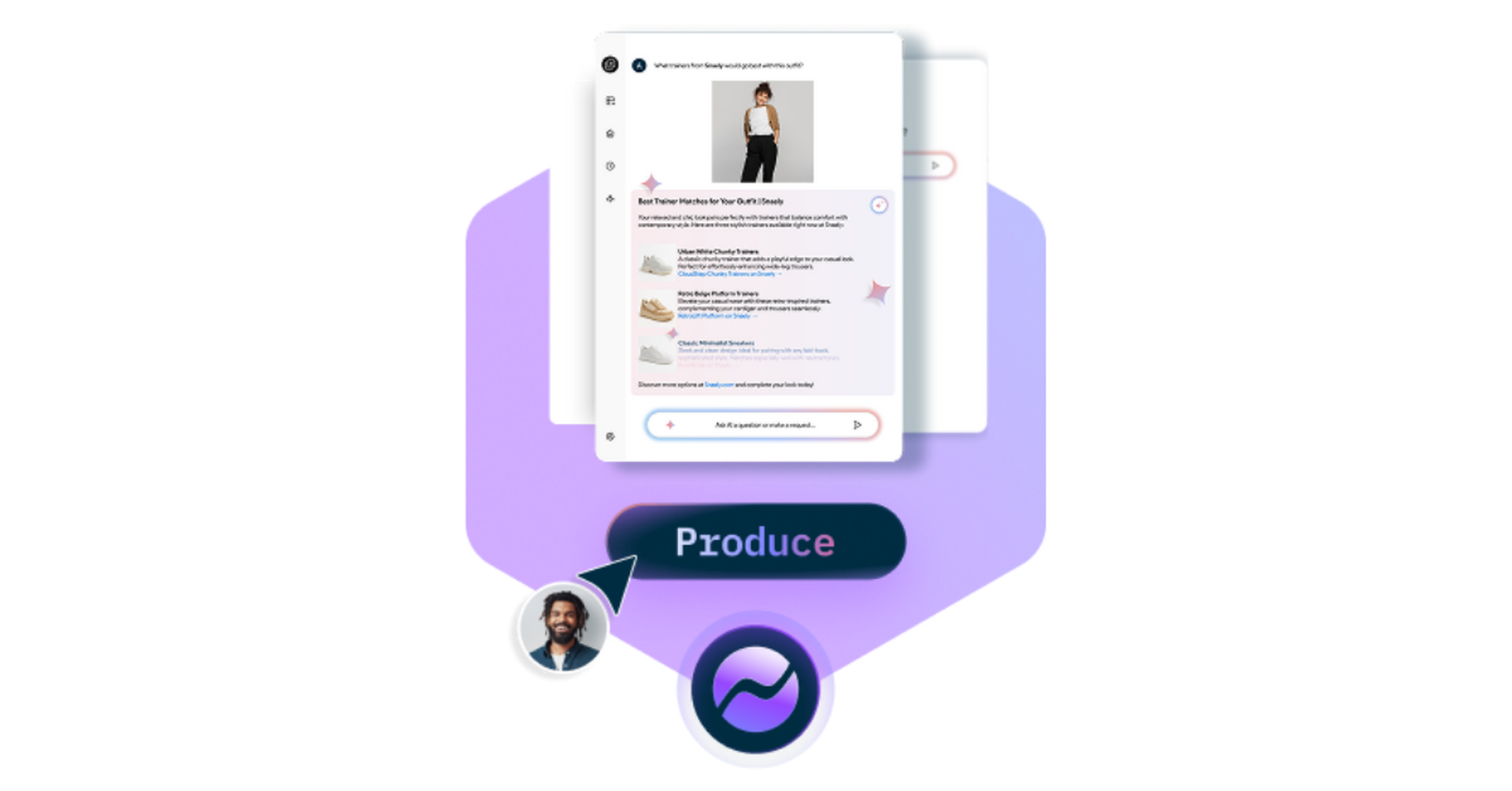
How enterprise retailers move at catalog scale with Amplience
Primark automated alt text generation across its catalog using Amplience Workforce and saved 9 hours per month on a task that had previously been written by hand for every image. Daily product description output increased by 70%.
Structure now, show up later
Your products are in tens of thousands of catalogs, feeds, and AI search indexes. Whether they show up in the answers AI generates for your customers comes down to whether your content is structured for it. Build this foundation now and the benefit shows up twice. Better AI visibility in search today, and the groundwork already in place when agentic transactions reach your category.